
Experiences and tickets for the Campanile
An updated selection of tickets to climb the Campanile, often combined with the Basilica and the Doge's Palace to optimise your day in St Mark's Square.
In short: the Campanile in 30 seconds
- Height
- 98.6 metres (including the gilded angel at the top).
- Climb
- Modern lift, no stairs for the public.
- Price
- About €12 (full), reductions and free entry for children.
- Average visit time
- 30–40 minutes, queue included at peak hours.
- View
- Venice's rooftops, the lagoon, the Dolomites on clear days.
- Access
- South side of the square, opposite the Doge's Palace.
Official data: basilicasanmarco.it. Always check before setting off.
A tower that collapsed and was rebuilt: history in brief
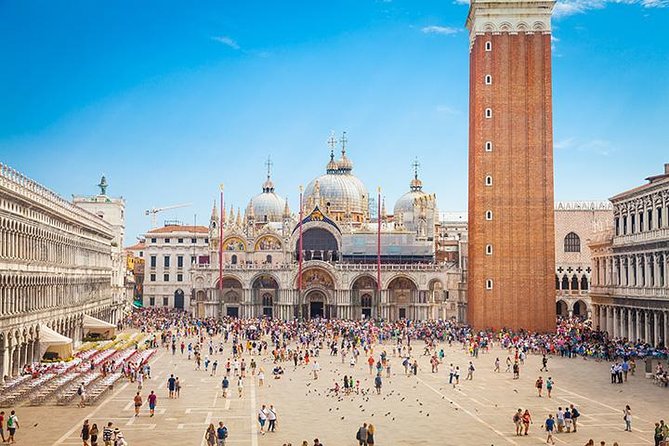
St Mark's Campanile — Venetians simply call it el paron de casa, "the master of the house" — is one of the city's symbols. Its history begins in the 9th century, when it was built as a watchtower over the lagoon harbour. Over the centuries it was altered several times, until it took its current form thanks to Bartolomeo Bon in the 16th century, with the white marble bell chamber and the pyramidal spire crowned by the weathervane angel.
The collapse of 14 July 1902
The most dramatic date in the Campanile's history is 14 July 1902. At 9:47 in the morning, after weeks during which Venetians had noticed ever deeper cracks in the perimeter walls, the tower collapsed in on itself. The fall was surprisingly "tidy": the huge mass of bricks slumped almost vertically, sparing the Basilica, the Doge's Palace and the Marciana Library. The only victim was the custodian's cat. The mayor of Venice, Filippo Grimani, uttered the line that became famous: "Where it was and as it was."
The reconstruction and 1912 inauguration
It took ten years to the day. The Campanile was rebuilt faithful to the original but with more modern techniques: reinforced perimeter walls, widened foundations and an internal structure designed to better withstand the bells' vibrations. It was inaugurated on 25 April 1912, the feast day of St Mark. Since then, every detail — from the red bricks to Sansovino's loggetta at the base — is a meticulous replica of the original tower.
How you go up: by lift, not stairs
Unlike other Venetian bell towers (such as San Giorgio Maggiore or San Vidal), St Mark's Campanile has a modern lift that takes visitors straight to the bell chamber, at about 50 metres' height. There are no public stairs: the climb is therefore accessible to those with reduced mobility, the elderly and small children.
The lift has a limited capacity (about 14 people at a time), which is the main bottleneck of any visit. At peak hours — typically between 11:00 and 14:00 — the queue at the base can reach 40–60 minutes. In low season it drops to 10 minutes.
What to expect at the top
You arrive in the enclosed loggia hosting the five historic bells, each with a name and a specific function. The Marangona is the largest and marked the start of the working day for the Arsenale carpenters; the Trottiera summoned the nobles to the Palace; the Mezza Terza announced the Senate's sittings; the Nona marks the ninth hour; the Renghiera, also known as Maleficio, was rung for capital executions.
The view: what you actually see from the Campanile
The bell chamber offers a 360-degree view. A practical orientation, clockwise from the north:
- North: the rooftops of the Cannaregio sestiere, the islands of Murano and Burano in the lagoon, and — on crystal-clear winter days or after a bora rain — the Dolomite range, with the unmistakable profile of the Tre Cime di Lavaredo.
- East: the Arsenale, the Lido inlet, and on exceptional days the Istrian coast and the Slovenian mountains on the horizon.
- South: the island of San Giorgio Maggiore with its slimmer bell tower, the Giudecca, and in the distance the Cavallino pine forest.
- West: the dome of the Salute Basilica, the Grand Canal winding to the Rialto Bridge, and the rooftops of Dorsoduro.
Opening hours
Official hours vary slightly with the season. Below are the typical figures published by the Procuratoria di San Marco.
| Period | Opens | Closes | Notes |
|---|---|---|---|
| April – September | 09:30 | 21:15 | Last entry 21:00 |
| October | 09:30 | 20:15 | Last entry 20:00 |
| November – Easter | 09:30 | 17:30 | Last entry 17:00 |
The Campanile can close without notice in strong winds, thick fog or during bell maintenance. Closure for acqua alta is rare because the tower obviously isn't reached by flooding.
Prices and tickets
| Type | Price | Notes |
|---|---|---|
| Adult full price | €12 | Single entry, timed slot |
| Reduced (6–18 years) | €7 | ID required |
| Children 0–5 | Free | Accompanied by an adult |
| Groups (over 12) | Dedicated fare | Booking required |
| Combo Basilica + Campanile + Doge's Palace | €40–55 | Varies with reseller |
The online ticket includes the timed-slot booking service: you pay a few euros more than at the desk, but you avoid the physical queue. From May to September, advance booking is practically essential at weekends.
When to go up to avoid the queue
After monitoring wait times across different seasons, the results are reasonably consistent:
- Very early morning (9:30–10:30): minimal queue, soft light over the lagoon, clearer air. The best slot of all.
- Late afternoon (17:30–19:30 in summer): medium queue, but golden light on the Basilica mosaics. Excellent for photographers.
- Sunset: very popular. Best to have a booked slot.
- Mid-day (11:00–14:30): worst, especially with cruise ships in town. The lift queue can exceed an hour.
Combined tickets: worth it?
Yes, especially if you only have one day in Venice. The Basilica + Campanile + Doge's Palace combo, with guided tour and priority entry, lets you see the square's three icons in 4–5 hours without separate queues. The saving over the three single tickets is usually 10–15%, but the real benefit is logistical: one booking, one guide, one meeting point.
If you have more time, consider separating the Campanile (early morning) from the Basilica (mid-morning, after 11:00 when the liturgy ends) and the Palace (afternoon). In the evening, a sunset climb is an experience that justifies a second ticket.
FAQ on St Mark's Campanile
Do you go up on foot?
No, the public only goes up by lift. There's no tourist staircase open.
Are there problems for those who suffer from vertigo?
The bell chamber is closed by metal grates: you look out through relatively small openings. The sensation of vertigo is much milder than on open balconies.
How long does the visit take?
On average 30–40 minutes from entry to return to ground level, queue excluded. At the top you typically stay 15–20 minutes.
Do the bells actually ring?
Yes, and if you're at the top when they start, the noise is considerable. They ring especially at noon and on religious feast days.
Can you take a pushchair up?
Yes, the lift allows it. Remember though that the upper chamber is narrow and crowded at peak times.
Book your climb to the Campanile
Live availability, instant confirmation, free cancellation on eligible tickets.