
Experiences and tickets for the Basilica
An updated selection of tickets to visit St Mark's Basilica, including packages that — on special occasions — allow access to the crypt.
In short: the crypt in 30 seconds
- Period
- 9th century, oldest part of the Basilica.
- Depth
- About 1.5 m below average high-tide level.
- Access
- Limited, only on special tours or extraordinary openings.
- What you see
- Romanesque columns, sarcophagi, ancient altars, traces of the first foundation.
- Visit duration
- Typically 20–30 minutes.
- Photos
- No flash, no tripods.
Official reference: basilicasanmarco.it.
A story that begins with a theft and a sea voyage
St Mark's Basilica was built for a very specific reason: to safeguard the relics of the holy evangelist. According to tradition, in 828 two Venetian merchants, Buono of Malamocco and Rustico of Torcello, smuggled the body of St Mark out of Alexandria in Egypt and brought it to Venice. The legend says they hid it under pork to get past Muslim inspections. From that moment St Mark became patron of the Republic and his remains the heart of the future basilica.
The first church and the 9th-century crypt
The first church was consecrated in 832, under Doge Giovanni I Partecipazio. The crypt — which served as its liturgical floor — was conceived as a custody for the relics. When, after the fire of 976, the basilica was rebuilt, the crypt remained: and to this day those Romanesque stones, those low columns, those rough capitals are the oldest piece of the entire complex. Walking through the crypt means walking through 9th-century Venice, when the city was still an archipelago of lagoon islands inhabited by fishermen and a young dogeship.
The relics
For centuries it was debated where St Mark's bones really were. Some scholars argue they were hidden during the fire of 976 and rediscovered by "miracle" in 1094 during the consecration of the current basilica. Today the relics are kept in the high altar, above the crypt. The crypt still contains minor sarcophagi, tomb slabs of doges and patriarchs, and the original altar, still visible in its central position.
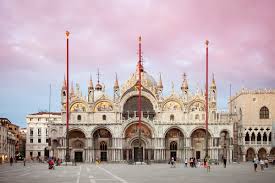
What you see in the crypt today
The space is intimate: around 200 m² in total, with low vaults supported by a forest of small columns. The light is soft and warm, the humidity tangible. The points not to miss:
- The central altar: a 10th–11th-century marble slab that, according to tradition, held the saint's body before the transfer to the high altar above.
- The sarcophagi: some dating to the early Christian period, reused for doges of the 12th–13th centuries.
- The Romanesque columns: short and stout, with rough foliage capitals. They show the pre-Byzantine style typical of the first Venetian churches.
- Traces of the original mosaics: in a few corners fragments of the original mosaic floor survive.
- The ancient well: in the western area, a small well-shaft already collected seepage water in the Middle Ages.
The battle against acqua alta
The crypt is the part of the basilica most exposed to flood risk. Sitting below average sea level, it has historically been the first area to flood during acqua alta events. For much of the 20th century it remained inaccessible, periodically submerged or soaked with salt damp.
The major restorations
Between the 1990s and 2000s a major waterproofing intervention was carried out: the floor was isolated by an air chamber, the masonry treated with desulphurising mortars, the columns consolidated. After the exceptional acqua alta of 12 November 2019 (187 cm), which once again invaded the crypt, further drainage and capital-restoration works were started. With the MOSE barrier in operation, public openings have become more frequent.
How you visit the crypt
Access to the crypt is not included in the basic Basilica ticket and is not always guaranteed. The typical options are three:
- Special guided tours: some operators run themed visits including crypt, Pala d'Oro, Treasury and Loggia. They are the most complete tours, 90–120 minutes long.
- Extraordinary openings: on certain liturgical feasts (St Mark on 25 April, Marian feasts) the crypt is open free for short periods.
- Religious or study group visits: the Procuratoria authorises access on a motivated request basis.
In all cases access is regulated: small groups, fixed route, limited duration. The access stairs are steep and the floors can be slippery.
Rules for photos and conduct
| Rule | Detail |
|---|---|
| Photos without flash | Allowed, no flash that damages the stones |
| Tripods and selfie sticks | Forbidden |
| Professional video | Only with written authorisation from the Procuratoria |
| Silence | Compulsory, sacred and contemplative environment |
| Dress | Shoulders and knees covered as in the basilica |
| Children | Admitted if supervised, steep stairs |
Expert tips for visiting the crypt
Having accompanied several groups of friends and readers into the crypt, here are the most useful tips:
- Book well in advance. Openings are rare and places few: with 2–3 months' margin you stand a better chance of finding availability.
- Pick the early morning. The acoustics are better and there are fewer people.
- Bring a light jacket. Even in summer the crypt is cool: the internal temperature stays around 15–17 °C.
- Study a bit of history first. Without context on the theft of the relics and the birth of the Serenissima, the crypt looks like a dark room with a few columns. With the context, it's one of the most moving places in Venice.
- Combine with the Treasury. Many tours that include the crypt also visit the Treasury: it's absolutely worth the price difference.
FAQ on St Mark's crypt
Is the crypt always open?
No. It is accessible only on special tours or extraordinary openings. Check the calendar before visiting.
Is it included in the Basilica ticket?
Not in the basic ticket. You need a dedicated tour or a package that explicitly includes it.
Is wheelchair access possible?
Access to the crypt is unfortunately difficult for people with reduced mobility: the stairs are steep and there is no lift.
How long does the visit take?
Between 20 and 30 minutes, included in most complete Basilica tours.
Can you touch the columns?
No. The surfaces are fragile and in many places restored with experimental mortars.
Book your visit to the Basilica
Tickets with priority entry, complete tours including crypt, Pala d'Oro and Treasury.