
Tickets and experiences for every area of the basilica
A selection of entry tickets, guided tours and combined accesses to fully cover all areas of St Mark's Basilica: nave, Pala d'Oro, Treasury, Museum and Loggia dei Cavalli.
In short: the floor plan in 30 seconds
- Layout
- Greek cross (four arms of equal length) with a central dome and four arm domes.
- Dimensions
- Length 76.5 m, width 62.6 m, central dome height 43 m.
- Visitable levels
- Three: crypt (below), basilica (ground level), museum + Loggia dei Cavalli (above).
- Entrances
- Central door (free), Porta dei Fiori (prebooked), Porta Sant'Alipio (exit).
- Paid interior areas
- Pala d'Oro, Treasury, Museum + Loggia dei Cavalli.
- Standard visit time
- 60 minutes for the full circuit at average pace.
Source: basilicasanmarco.it.
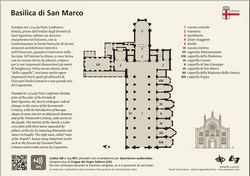
The Greek-cross layout: what it is and why
St Mark's Basilica is one of the purest examples of a Greek-cross plan in the West. Unlike the Latin cross (with one much longer arm, typical of Romanesque and Gothic cathedrals), the Greek cross has four arms of roughly equal length arranged around a central point.
The plan comes directly from Byzantine architecture, in particular from the now-destroyed Church of the Holy Apostles in Constantinople. When in 1063 Doge Domenico Contarini ordered the basilica to be rebuilt for the third time, he explicitly chose this Eastern model: a political as well as religious statement.
The features of the plan
- Four equal arms forming an equilateral cross within a square.
- Five domes: one at the centre, one on each arm.
- Centripetal space: the eye is constantly drawn back to the crossing.
- Wrap-around plan: the narthex surrounds the basilica on three sides (west, north and partly south).
The areas of the basilica seen from above
Here are the main spaces in logical visit order, starting from outside.
| Area | Position | What it contains | Access |
|---|---|---|---|
| Narthex | Wraps the church in a U, west and north sides | Old Testament mosaics, lunettes, sarcophagi | Included in basic ticket |
| Central nave | West arm of the cross | Pentecost dome, marble pavement | Basic ticket |
| Crossing | Meeting point of the arms | Ascension dome (the largest) | Basic ticket |
| North transept | Left arm | St John's dome, access to the Museum | Basic ticket / Museum separately |
| South transept | Right arm | St Leonard's dome, entrance to the Treasury, limited access to the Crypt | Treasury separate ticket |
| Sanctuary | East arm, beyond the iconostasis | High altar, Pala d'Oro, relics of St Mark | Pala d'Oro separate ticket |
| Crypt | Below the sanctuary | Romanesque underground chapel, ancient doges' tombs | Special visits or guided tours |
| Museum | Upper floor | Original bronze horses, tapestries, detached mosaics | Separate ticket |
| Loggia dei Cavalli | External façade, upper floor | Four horses (copies), view over St Mark's Square | Included in the Museum |
The narthex: the basilica's threshold
The narthex is the first space you cross on entering through the Central Door. It is a long, low, dimly lit space running along three sides of the basilica (west, north and partly south). It acts as "decompression" between the light of the square and the mystery of the sacred hall.
In plan, the narthex is made up of a series of square bays, each topped by a small dome. Above every dome, gold-ground mosaics with scenes from the Old Testament: Genesis, Noah, Abraham, Joseph, Moses.
What to do in the narthex
- Look up at every bay: each dome is a chapter of the Bible.
- Notice the floors: the narthex marble inlays are even older than those inside.
- Search for the Porta di San Clemente, in 12th-century gilded bronze, decorated with figures of saints.
The nave and the transepts
Once past the narthex you enter the main space. The plan is clear:
- Central nave (west): the arm of the cross you are in immediately on entering, with the Pentecost dome overhead.
- North transept (left): dome of St John the Evangelist. The staircase to the upper-floor Museum starts here.
- South transept (right): dome of St Leonard. Here is the entrance to the Treasury and, on some occasions, access to the Crypt.
- Sanctuary (east): the eastern arm, separated from the nave by the iconostasis, contains the high altar and the Pala d'Oro.
On the four sides of the central crossing, above the arcades, narrow galleries (matronea) open out: they were reserved for the clergy and are not visitable today.
The sanctuary and the Pala d'Oro in the plan
The sanctuary is separated from the rest of the basilica by the marble iconostasis of 1394. To enter it you need a specific ticket (about €5). Once inside, the route is fixed:
- You enter through a side opening to the right of the iconostasis.
- You walk clockwise around the high altar.
- You arrive in front of the Pala d'Oro, displayed vertically at the back of the altar.
- You step down and exit on the left.
The loop takes 5–8 minutes and is visually intense: you see alabaster columns, Byzantine sculptures, ciborium, choir stalls and finally the Pala. It's one of the most concentrated parts of the visit.
The Treasury: where to find it on the plan
The Treasury occupies two small rooms in the south-east corner of the basilica, between the right transept and the sanctuary. The entrance is a bronze door, easy to spot, marked "Tesoro / Treasury".
The two rooms are actually ancient spaces of the adjacent Doge's Palace, absorbed into the basilica after the 11th-century enlargements. The thicker wall is the southern one, which abuts the Doge's Palace.
The crypt: the underground level
Beneath the sanctuary stretches the crypt, a small church within the church: three little aisles, low vaults, a forest of stubby columns. It is the oldest level still visitable, mostly dating from the 11th century.
Here, until 1094, the relics of St Mark were kept: the sarcophagus was later moved upstairs, under the high altar, where it still rests. Many ancient doges and patriarchs of Venice are buried in the crypt.
Access is limited. Lying below sea level, the crypt is frequently flooded and is only opened during dry periods, on special services or in dedicated guided tours.
The Museum and Loggia dei Cavalli on the upper floor
A narrow staircase in the south transept (or, depending on visitor flow, in the narthex) leads up to the first floor. Here is the Basilica Museum, spread across rooms along the internal galleries and the façade.
The Museum holds the original four gilded bronze horses, ancient masterpieces brought to Venice from Constantinople in 1204. On the outdoor loggia you see copies. There are also 16th-century tapestries, mosaics detached during restorations, illuminated manuscripts and liturgical vestments.
What the external loggia offers
- A privileged view of St Mark's Square from above: one of the best photographic vantage points in Venice.
- A close-up look at the Gothic statues of the façade.
- The chance to observe the external mosaics almost within reach.
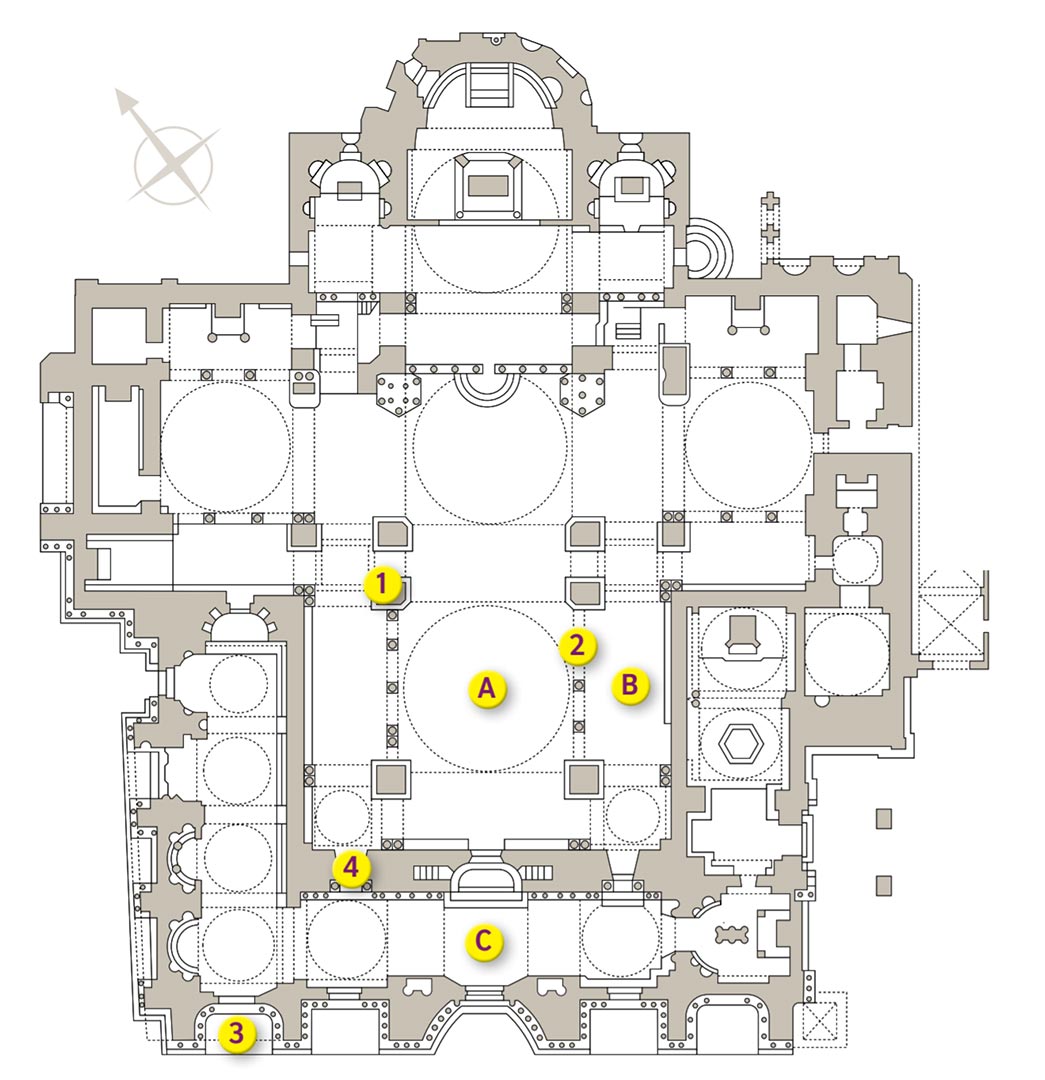
Optimised 60-minute visit itinerary
If you have exactly one hour, here's how to budget your time to see everything without rushing.
| Minute | Area | Activity |
|---|---|---|
| 00–08 | Narthex | Domes of Genesis, Noah, Babel. Long view towards Pentecost. |
| 08–15 | Central nave | Pentecost mosaics, marble pavement. |
| 15–22 | Crossing | Ascension dome: stop in the centre and turn. |
| 22–28 | North transept | St John's dome. Glance at the matroneum. |
| 28–34 | South transept | St Leonard's dome, entrance to the Treasury. |
| 34–45 | Sanctuary + Pala d'Oro | Clockwise loop, long pause in front of the Pala. |
| 45–55 | Treasury | Main showcases, chalices and Byzantine icons. |
| 55–60 | Exit | Final overall look from the south door. |
For the "long" 90–120 minute version add 30 minutes of Museum + Loggia dei Cavalli.
The doors: how to enter and where to exit
The west façade (the one facing St Mark's Square) has five large portals. From north to south:
- Porta di Sant'Alipio: the leftmost. Above it, the only original medieval external mosaic, depicting the translation of St Mark's body.
- Porta di San Pietro.
- Central Door: the main entrance for visitors without a booking (free queue).
- Porta di San Clemente.
- Porta di San Giovanni: the rightmost.
On the north side, towards the Piazzetta dei Leoncini, opens the Porta dei Fiori, reserved for visitors with bookings (skip the line, guided tours). The "prebooked" queue forms here.
Exit usually happens from the south side (towards the Doge's Palace) or from the same Central Door, depending on the day's visitor flow.
Orienting yourself by the compass
The basilica is oriented with the sanctuary (the high altar) towards the east, following ancient Christian tradition. That means:
- Entering through the main façade, you look east, towards the Pala d'Oro.
- Your left is north: behind you are the Clock Tower and the Procuratie Vecchie.
- Your right is south: behind you are the Doge's Palace and the lagoon.
- Behind you is west: the length of St Mark's Square.
This mental compass helps you read any printed basilica map without getting confused.
Floor plan numbers to remember
- 76.5 m: external length (west–east axis).
- 62.6 m: external width (north–south axis).
- 43 m: internal height of the central dome.
- 5: main domes.
- 500+: columns of marble, granite, alabaster.
- 8,000 m²: total mosaic surface.
- 2,099 m²: surface of the historic marble floor.
- 1,500: authorised maximum simultaneous capacity.
FAQ on the floor plan of St Mark's Basilica
Why does the basilica have a Greek-cross plan and not a Latin one?
By explicit choice of Doge Contarini in 1063, who wanted to reproduce the Church of the Holy Apostles in Constantinople, the Byzantine model par excellence — also as a political gesture of closeness to Eastern Christianity.
Can the crypt be visited?
Only occasionally. Lying below sea level, it is often flooded. Access is reserved for specific guided tours or special openings.
Where do you enter with a booked ticket?
Through the Porta dei Fiori, on the north side of the basilica, on the Piazzetta dei Leoncini. Look for the "Prebooked entrance" sign.
Is the Pala d'Oro included in the basic ticket?
No. To access the sanctuary and see the Pala you need a separate interior ticket of about €5.
How big is the interior?
The Greek-cross plan measures about 76 × 62 external metres; the central dome is 43 metres high.
Can I download a map of the basilica?
The official site basilicasanmarco.it offers printable brochures. At the entrance, staff also hand out free folding maps in the main languages.
Book the full-circuit visit
To explore every area of the basilica — narthex, nave, sanctuary with Pala d'Oro, Treasury, Museum and Loggia dei Cavalli — a ticket that includes the paid accesses or a dedicated guided tour is worthwhile.