
Experiences and tickets to visit the interior
An updated selection of entry tickets, guided tours and accesses that include Pala d'Oro, Treasury, Museum and Loggia dei Cavalli. Advance booking strongly recommended all year round.
In short: what to see inside in 30 seconds
- Mosaic surface
- About 8,000 m² in gilded and polychrome tesserae, 11th to 19th century.
- Main domes
- Five: Pentecost, Ascension, Emmanuel, St John, St Leonard.
- Pala d'Oro
- Byzantine altarpiece with 1,927 gems and 250 enamel plaques, behind the high altar.
- Treasury
- Over 300 works of sacred goldsmith work, partly from the spoils of the Fourth Crusade (1204).
- Floor
- 2,099 m² of polychrome marble inlay from the 11th–12th century.
- Recommended visit time
- 75–120 minutes to see everything calmly.
Source: basilicasanmarco.it and Procuratoria di San Marco.
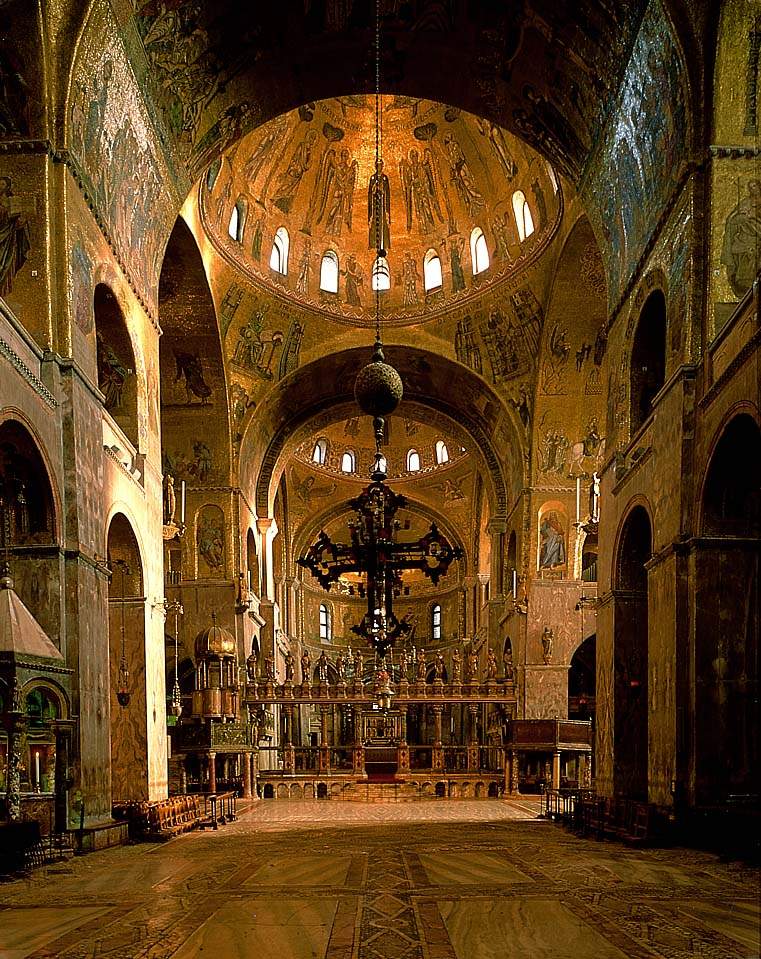
The mosaic light effect: why they shine
The first sensation, as you cross the threshold, is one of stepping into a gold box. The effect isn't accidental but the result of a precise technique.
The mosaic tesserae are of Murano blown glass, with a very thin sheet of gold inserted between two layers of transparent glass. Each tessera is tilted by a few degrees relative to its neighbours: even weak light is reflected in a thousand different directions.
The result is a surface that changes tone with every step. In the morning, the Pentecost dome appears blue-green; in the late afternoon it turns a deep orange. It is a work of kinetic art a thousand years ahead of the twentieth century.
The narthex: the Bible told in mosaic
Before entering the basilica proper you cross the narthex, built in the 13th century and almost entirely decorated with gold-ground mosaics between 1215 and 1280.
It contains the oldest, best-preserved cycle in the whole basilica. The iconographic programme follows the Old Testament: it starts with the Creation of the world in the dome above the entrance and reaches the story of Moses in the last bay on the right.
What to look for in the narthex
- Dome of Genesis: 26 episodes of creation arranged in three concentric bands. The Holy Spirit appears as a dove over the waters.
- Stories of Noah: building the ark, animals in pairs, the flood, the rainbow. Note the care in zoological detail.
- Tower of Babel: a rare iconography in which the bricklayers speak different languages, rendered through gestures.
- Story of Joseph: three whole domes devoted to the biblical patriarch, with surprisingly realistic scenes of Egyptian life.
Keep looking up: in five minutes in the narthex you'll see more biblical scenes than in many whole churches.
The five domes: the geography of the Venetian sky
The Greek-cross plan places a dome at the centre and one on each arm. Each dome has a precise theological theme and a dominant colour driven by the mosaic programme.
| Dome | Position | Subject | Mosaic period |
|---|---|---|---|
| Pentecost | Above the entrance (west) | Descent of the Holy Spirit on the apostles | 12th century (the oldest) |
| Ascension | Central | Christ risen to heaven, apostles, virtues | 13th century |
| Emmanuel | Sanctuary (east) | Christ prophesied, prophets, Virgin | 12th century, 19th-century restoration |
| St John | North transept | Life of St John the Evangelist | 12th century |
| St Leonard | South transept | Four Venetian patron saints | 13th century |
Pentecost Dome
The first you see on entering, and also the oldest. At the centre, the empty throne (Etimasia) with the dove of the Holy Spirit, from which twelve rays touch the heads of twelve apostles arranged in a circle. Below, between the windows, sixteen pairs of converted peoples: each pair has different clothes, headdresses and facial features.
Ascension Dome
The largest and most spectacular: 13 metres in diameter. Christ is enclosed in a mandorla carried by four angels; below, the Virgin in prayer between two angels, and all around the apostles standing on a green meadow, separated by stylised trees. In the lower ring, the fourteen virtues personified as women.
Emmanuel Dome
Above the high altar. At the centre a youthful Christ (the Emmanuel, "God with us"), surrounded by the Old Testament prophets who announce him. It's the most reworked dome in the 19th-century restorations: some prophet figures are modern additions.
St John's and St Leonard's domes
The two lateral domes. The dome of St John tells the evangelist's life; the smaller dome of St Leonard hosts four half-length saints in gilded clipei: Leonard, Nicholas, Clement and Blaise, especially dear to Venetian sailors.
The Pala d'Oro: the Byzantine masterpiece behind the altar
If you buy the specific interior ticket, you access the area behind the high altar where the Pala d'Oro sits. It is, objectively, one of the most important works of medieval goldsmith art in Europe.
Its dimensions: 3.48 metres wide, 1.40 high. Its contents: 250 Byzantine cloisonné enamel plaques set in a 14th-century gilded silver Gothic frame, studded with 1,927 gems — pearls, emeralds, amethysts, rubies, garnets, topazes, sapphires.
How the Pala is built
The structure has two superimposed registers. Above, seven larger plaques show the Archangel Michael at the centre, scenes of the life of Christ to the sides. Below, in the centre, Christ Pantocrator enthroned, surrounded by the evangelists; on the sides, prophets, apostles, angels, saints.
Three stages of history
- 976–1105: first commission from Constantinopolitan workshops by Doge Pietro Orseolo.
- 1209: new plaques arrive from the spoils of the Fourth Crusade and from Constantinople itself.
- 1342–1345: the Venetian goldsmith Giampaolo Boninsegna reassembles everything in the current Gothic frame.
What to look at up close
- The hands of Christ Pantocrator: the enamel renders the veins under the skin.
- The Virgin's cloak at the centre: a deep cobalt achieved by fusing lapis lazuli into the glass.
- Greek micro-inscriptions around every figure: names and liturgical titles.
Iconostasis: the screen that hides the mystery
Between the nave and the sanctuary stands the iconostasis, a structure typical of the Byzantine tradition and exceptionally rare in Italy in this form. It dates from 1394, by Jacobello and Pierpaolo Dalle Masegne.
Eight columns of grey marble support an architrave on which fourteen statues are arranged: the Virgin at the centre, the apostle Mark and the twelve apostles to the sides, with a large silver crucifix dominating the perspective. It's a physical boundary, but also a theological one: behind lies the sacred, in front the people.
The Dalle Masegne statues are one of the first cycles of free-standing Venetian Gothic sculpture. The folds of the robes, the subtle movement of the faces: we are already a step away from the Quattrocento.
The sanctuary and St Mark's altar
The high altar rests on four columns of oriental alabaster, carved in bas-relief with scenes from the New Testament. They are 6th-century Byzantine works brought to Venice from Constantinople, but for centuries they were believed to come from the ancient Temple of Solomon — a legend nurtured by the Republic to lend prestige to the basilica.
Beneath the altar, in a sarcophagus, lie the relics of St Mark the Evangelist, brought there in 1094 after being translated from Alexandria in 828 by two Venetian merchants who, according to tradition, hid them under pork to fool the Muslim customs officers. It is the mythical founding act of Venice as a Christian power.
What to observe in the sanctuary
- The ciborium (baldachin) above the altar, with story-carved columns.
- The marble plutei with inlay that close the sides of the choir.
- The 15th-century choir stalls in carved wood with perspective inlays.
- The twin ambons (pulpits) on either side: one for readings, one for dogal announcements.
The Treasury: crusader booty and faith
The entrance to the Treasury is in the right transept, through a bronze door. It's a small, austere room with low display cases: anyone expecting Topkapi-style sparkle is wrong-footed, but the value here isn't scenographic, it's historical.
About 300 objects of sacred goldsmith work are preserved here — chalices, reliquaries, icons, lamps, processional crosses. Many pieces are loot from the Fourth Crusade, when in 1204 the Venetians led by Doge Enrico Dandolo sacked Constantinople.
Must-see pieces
- Chalice of Doge Romanus, in sardonyx agate with a gold handle.
- Icon of the Archangel Michael, 12th-century Byzantine enamel.
- Glass cup with fish-shaped handles (Sasanian work, 7th century).
- True Cross reliquary, gifted by the empress of Constantinople.
A visit to the Treasury takes 15–20 minutes. The ticket costs a few euros extra. Worth it mainly for those with art-historical interest.
The marble pavement: a work of art beneath your feet
2,099 square metres of marble inlay, mostly from the 11th and 12th centuries. Few people look at it because the eye is captured upwards, but St Mark's pavement is one of the most important in Italy.
The motifs are geometric and zoomorphic: circles, hexagons, interlocked octagons, but also peacocks, griffins, deer, birds. The technique is opus sectile: sheets of coloured marble cut and assembled like a puzzle.
The floor isn't flat. As you walk you feel waves underfoot, the result of thousand-year-old settling of the lagoon ground. It's a permanent alarm bell for the Procuratoria's restorers.
Three spots to pause
- At the centre of the nave: red porphyry and green serpentine rosette.
- In the left transept: the four tetramorphs (lion, eagle, bull, angel).
- At the entrance to the sanctuary: the "wheel of fortune" with the months of the year.
The columns and marbles of the nave
More than five hundred columns support the structure, and almost no two are alike. Greek, Egyptian, Asian, Syrian marbles: the basilica is an almost encyclopaedic catalogue of ancient stones, many salvaged from pagan temples dismantled after the Crusades.
Particularly precious are the Thessalian verde antico columns, the Euboean cipollino and the Phrygian pavonazzetto. Some still bear traces of Greek inscriptions or ancient classical capitals re-adapted.
Suggested itinerary for a good interior visit
- 0–10 min — Narthex: domes of Genesis, Noah, Babel, Joseph.
- 10–20 min — Central nave: Pentecost dome, pavement, overall view.
- 20–35 min — Crossing: Ascension dome at the centre, side transepts.
- 35–55 min — Sanctuary and Pala d'Oro (separate ticket).
- 55–70 min — Treasury (separate ticket).
- 70–90 min — Museum and Loggia dei Cavalli (upper floor, by the staircase at the far right).
Practical rules inside the basilica
- Silence: it's a place of worship, low voices required.
- Dress: shoulders and knees covered. Bring a light shawl in summer.
- Large backpacks: forbidden. Free deposit at the nearby "Ateneo San Basso".
- Photos: generally allowed without flash or tripod; professional shoots require authorisation.
- Animals: not admitted (except guide dogs).
FAQ on St Mark's Basilica interior
How long is a complete interior visit?
For mosaics, domes, floor and narthex: 30–40 minutes. With Pala d'Oro, Treasury and Museum it rises to 90–120 minutes.
Are all the mosaics original?
No. The majority are medieval (11th–13th centuries), but many sections have been restored or remade between the 16th and 19th centuries. Some cartoons were signed by Tintoretto, Veronese and Titian.
Can you see the Pala d'Oro without a ticket?
No. The Pala is behind the high altar, in an area only accessible with a specific ticket (about €5 extra).
Can you visit the basilica during mass?
Tourist access is suspended during services. For the faithful, entry is always free, but in limited areas.
Is it worth going up to the Museum on the upper floor?
Yes, especially for the Loggia dei Cavalli, from which you can photograph St Mark's Square from above and see the four original bronze horses up close.
Can you touch the columns or marbles?
Better not to. The historic marbles are fragile and skin oils damage them. Staff supervise actively.
Book your interior visit
To really enjoy the mosaics, the Pala d'Oro and the domes you need time: by booking priority entry and optional accesses you save 30–90 minutes of queue and visit at your own pace.